Friday, July 25, 2014

A Murder in Town


Matthew Gamlin  (1879-1949)
I was probably around twelve years old when my Mom showed me an article from the November 19, 1914 issue of The Raymond News about the death of my grandfather's first wife (the original article is below). I was surprised to learn that my grandfather was married to another woman before he married my grandmother, and was shocked to learn that the "other woman" was murdered by one of my own family members. I have been fascinated by this story ever since.

The woman who died was Mary Bechtel Carriker Gamlin. She was known as "Molly" and she was the aunt of Phyllis (Bechtel) Peger. Joe Gamlin (my grandfather), had known Molly for a few years because she had courted and eventually married his best friend, Jess Carriker. Molly and Jess lived in Decatur where Jess was in the restaurant business. Jess was hit and killed by a train in 1912. When Joe got word of Jess' death, he contacted Roscoe Hough right away, and the two of them traveled to Decatur in Hough's horse drawn black hearse to bring Jess Carriker's body back to Raymond. It was Joe who comforted Molly, Joe who brought Molly back home, and Joe, who became her second husband. As you might imagine, the intricacies of Joe and Molly's relationship with each other did not go unnoticed by the townsfolk.

Wilma and Joe Gamlin in the 1940's
Joe and Molly were married on November 4, 1914. They had just returned from their honeymoon and were staying at the home of Joe's parents in Raymond, a large two-story house on the edge of town (in the vicinity of the present day West End). One of Joe's brothers, Matthew Gamlin, lived at home with his parents. In 1908, Matthew had attended a seminary where he was studying to become a Presbyterian minister. While away, he was overcome with an illness and high fever that led to brain damage. His condition was so severe, that he had been institutionalized before eventually returning home to his parents.

As the Gamlin family and a neighbor gathered around the kitchen table for breakfast, cheerfully discussing the honeymoon and the charivari hosted by their friends the night before, Matthew Gamlin walked downstairs carrying a double-barrel shotgun. With no warning, he shot Molly in the face at close range. My great-grandmother's warm kitchen turned into a murder scene that morning. The force of the blast pushed Molly against the back of the chair and into the wall. She came forward again, in slow-motion, her torso crashing down on the kitchen table, silverware, glass, and bits of china flying in all directions. In a matter of seconds, a massive amount of blood began soaking into her white lace blouse, and trickled down onto the floor, pooling beneath her black, high-buttoned boots. The gunshot shook the house, rattling the teacups in the china cabinet in the sitting room. 

I've often thought about the lives that were changed that day. Poor Molly who suffered so much pain in her short life was gone, and the man who would become my grandfather was left with nothing but memories and a photo of a young, pretty woman with jet black hair that he would carry in his wallet for the rest of his life. And then there was the Bechtel family who lost a young daughter, and the Carrikers' who, within a span of a couple of years, had lost their son and former daughter-in-law.

Matthew Gamlin was sent to the Asylum for the Insane at Jacksonville. Joe personally accompanied his brother to Jacksonville, just the two of them traveling alone in Joes' horse and buggy.

In 1918, Joe Gamlin married Wilma McCallum, and they farmed south of Raymond for three years before moving to what was later known as Anderberg Hill (located on the Nokomis Blacktop, opposite of Mulch's hill). Their only child, Eileen (my mother), was born there in 1924.

Security at the mental hospital in Jacksonville was relaxed, and Uncle Matt would sometimes wander off. On these occasions, the hospital would notify my grandparents that Matt was missing. Grandma was terrified that he was on his way back to kill her, just like he had killed Molly, and she refused to be in the house alone. When grandpa was at work, grandma would take my mom outside and they would sit on the well on the top of the hill, scanning the fields, watching for any sign of him. My grandma's torture went on for years, until Matthew Gamlin died on November 1, 1949.

Joe did not want Matt to be buried anywhere near Molly's grave in Asbury Cemetery, so his body was placed a few rows away in an unmarked grave near some of our other Gamlin relatives. Shortly before my Mom died in 2008, she had a small grave marker placed at the site. I was glad she did that.

I am a firm believer that everything happens for a reason. Although this story is tragic, I'm thankful that the events happened exactly the way they did, and that I am here to talk about it!


Thursday, July 17, 2014

It happened one summer...

Grain bin mishap at Sorrells' Elevator in 1994

1973

July - Westwood Acres Subdivision was developed by Gerald and Carl Murphy. The two new streets were named Lincoln and Maple.

July - The Hough family celebrated 75 years in the funeral home business in Raymond.

1978

July - The First National Bank celebrated their 75th anniversary. Raymond "Jiggs" Hough was President.
August - Construction began on the new ambulance shed on Rt. 48 near the water tower. 


1980

July - Bernard and Margaret Jenkins lost their home to a fire.

1983

June - The Raymond-Harvel Kiwanis celebrated their 25th Anniversary with a special dinner and awards program.

1986

June - Frank Doyle died, leaving bequests that benefited the entire community.


1987

June - The LHS Band went to Washington, D.C. and performed a concert for 5,000 people who were waiting to tour the White House. 


1990

July - Raymond won the "Governor's Home Town Award for volunteer work on Shoal Creek Golf Course.


1992

July - A propane tank blew up at the Pork Producers stand during the Raymond Independence Day Celebration, injuring Roy Weitekamp and Jeff Hampton.


Summer of 1993

The Mississippi and Illinois rivers rose to record levels over the summer. Many Raymond residents participated in sandbagging operations, and donated money, food, clothing, and supplies for flood victims.
Melvin and Helen Bruntjen were busy enjoying their seven new great-grandchildren who were all born within five months of each other.


1994

June - The community mourned the loss of Jessica Cray, the daughter of Joe and Judy Cray, who was killed in a farm accident. She had just completed 6th grade at Raymond Junior High.

August - The underground gas tanks at LHS were removed under the supervision of the EPA and State Fire Marshall. The cost of the project exceeded $197,000.

August  - A 28,000 bushel grain bin filled with wheat at Sorrells' elevator buckled and leaned toward the railroad tracks.

August - St. Raymond's Knights of Columbus #4696 dedicated a memorial at St. Raymond's Cemetery honoring all unborn children.


Lester Walch tending to the community planter in front of his store.

1995 

June - The Village Board purchased planters to "beautify" the downtown area.

June - Members of the Raymond United Methodist Church commemorated the church's Centennial year by burying a time capsule that was donated by the Hough family. Items placed in the time capsule included memorabilia from the Centennial celebration, Sunday School notes and class lists, and the present membership list. The church members hope the capsule will be opened in 2095.

August - The Pleasant Hill Christian Church sponsored a mission trip to Juarez, Mexico. Those who attended from Raymond included Evelyn, Natalie, and Sarah Boehme; John, Patty, Lacy, Dustin, and Dane Fletcher; and Judy Miles.

1996

July - Raymond celebrated "125 Years of Memories."

Thursday, July 10, 2014

Memories of Main Street

Main Street in the early 20th Century
 I can't tell you how many times over the years I have wondered about things from "back in the day," and have wished I would have asked my parents a lot more questions and recorded the information. Fortunately, life-long Raymond resident, Anna Uhrig, enjoyed writing and she shared her memories in Raymond's 125th Anniversary Book that was published in 1996.

Anna was the daughter of William and Margaret Coen Fireman. She married John Uhrig (son of Thomas and Druscilla Hebenstreit Uhrig) at St. Raymond's Church in 1927. For fifty years, the couple lived at the junction of Route 66 and Route 48, and according to the Uhrig family history printed in Raymond's Anniversary Book, it was quite an experience: People stopped by to use the telephone, to call for help at a wreck, or because they had run out of gas. The orchard fence was damaged so many times by wrecks, it was finally removed when the road was widened. The white chickens were quite an advertisement and many eggs were sold to customers from St. Louis to Chicago. Later, the Stop Lite Cafe and Standard Service Station were built on the corner.

Anna eventually moved to town, where, according to the book, she spent her time crocheting, quilting, and writing verses. She was a sweet lady, and I am so thankful that she took the time to record her memories of Raymond:  

Anna Uhrig

As I Remember Main Street
by Anna F. Uhrig


Having lived near and around Raymond, and now in Raymond, for all of my soon to be ninety years, I Anna Uhrig, have recollections of many services no longer on Main Street, now Broad Street. I was born on a farm six miles north of Raymond and at the age of five, and moved with my family to a farm southeast of Raymond, which was my home until my marriage in 1927. I lived in the square white house on the comer of the junction of Routes 127 and 48 and I-55 for the next 50 years and now I am in town, just a half block off Main Street, now Broad Street. 

Memory tells me that the present library was the home of the Doyle family whose son donated the home for the library. The present home of Veda Slightom was owned by the Dr. Kenton family who had two sons, Harold and Bruce.

Part of the Mizera home, by the present bank, was the sacristy of the old St. Raymond Church which was tom down when the present St. Raymond Church was built. The First National Bank stands on property that was Ira Doyle's Livery Stable where you could rent a stall horse for horses being ridden or driven to High School. Later, Henry Bergman had a black smith shop there where he shod horses and sharpened plow shares.

Another view of Main Street in the early 20th Century
On the local Post Office site was a large wooden two story building that housed Whalen's Poultry and Egg Station. Mr. Newt Scott drove a wagon through the country, collecting poultry and eggs from the local women.

The Walch store of memorabilia across the street, housed Roy Reineke's Hardware Store where new stoves could be purchased as well as hardware. Later, the Raymond News was published there.

The present bowling alley was the local theater where pictures and many local plays were given. In fact, my High School graduating Class of 1924 received our diplomas on the stage as that part of the new Community High School had not been finished. On one side of the entrance to the theater was Gutherie's Jewelry Store and the other side was Dr. Driskell's office. Later, Boss McConathy had a barber shop there. The present school office housed the First National Bank. J.E. McDavid, Clarence McNaughton, D.D. Cox, and Alvin Carriker were officers there for many years.

Perry Donini (brother of Dot Pinkston), owned and operated the Raymond Food Market on Main Street from 1936 - 1978. 
Next in line was a grocery store owned by A.W. Foster, and later by Perry Donini. An exercise gym, The Lift Station, now occupies the space.

The Dance Studio was a pool room owned by Ted Lessman, then by Gino Casolari. When he died, his wife Louisa ran the business for several years before returning to Italy.

One of the Walch's stores was a millinery store, run by the Werts sisters who hand-made many of the beautiful hats sold there. The middle Walch Electric Store was Elmer Eickoff's Feed Store.

The next building was a beauty shop occupied by Margaret Jenkins, and later by Irene Brachear.

The present town hall was the Raymond Post Office. The Post Mistress was Miss Mayme Convery, assisted by her nephew, John Convery, who later became Postmaster.

The corner wash was Stoeveners Mens Clothing Store. Above it was the local dance hall, before the Legion Hall was built.

Across the railroad tracks was the Carlin Jones Lumber Company, managed by Sam Scherer and daughter Gladys, which later closed and was recently torn down.

The next block contained Mosby's Garage, a Kroger Store which later moved to Mizera's location, and the Raymond Cafe which was operated by various owners including Loretta Lessman. There was also a beauty shop owned by Temple Hough. In the early twenties, there was a variety store run by a Mr. Drake, and next, Sellers Grocery Store, also Elmer Carriker's barber shop. The Ford Garage was always a car dealership, again with various owners/managers, including Roman Herman, and now Glen Myers and Joe Martin.

George Haarstick owned and operated the Implement Store along Route 48. Later the Paul Brothers, and still later Leo Hannon operated the store. It is now occupied by Myers Radiator Shop.

Now, lets look across the now Route 48, where Deak Lewey ran the Shell Service Station. He was also the Saturday night banker for High Schoolers on dates - a few extra dollars added to the gas fill-up.

In crossing main street, we find a bus stop and gas station run by Alva McNeil. Local girls in nurse's training at St. John's caught the Sunday bus back to Springfield.

In that same block was Thacker's Grocery Store run by daughter Sara. Benning Equipment was a Case Dealer for many years, and Hanks Boats occupied a store before he moved to larger quarters along Route 48.

Ray Walch's Jack Shop and Lawn Mower Repair flourished for several years. Harris Barber Shop - where I got my long tresses changed to a short bob and styled neck line.

Emmett Hughes ran a harness Shop where the comer apartments are now located. He repaired harnesses as well as sold brass trimmed heavy duty sets of harness.

The Sorrells Elevator was managed by Frank Todt and later by others including Bob Deardorf. The present Sorrells Building on the comer was formerly the Raymond State Bank manned by Charles Scherer and later it was the dentist office of Dr. W.H. Scherer ably assisted by Mrs. Emma Seward. The back portion of the building was an apartment of Miss Blance Grubb, a retired school teacher.

Where the Legion Hall is now was a large frame two story house - The Raymond Hotel. Guests were stopovers from the Wabash Railroad Depot.

In the empty space next was the Raymond Mutual Telephone Office. Yes, Raymond had two telephone companies at one time. The other space now empty was Leo LaPlant's Restaurant. He was assisted by wife Elda for many years.

Harold Henderson sold pianos in one of the stores near by. Elmer Eckhoff operated a feed store, now occupied by Super Scissors and Slightom Insurance.

Mr. and Mrs. Gus McLean lived above his dry goods store. Miss Bertha Thompson was a loyal sales clerk. They later built the home now occupied by the David Mills family.

John Fehr had a shoe repair shop along that side also.

George Back and his wife operated Backs Ice Cream Parlor where the Edge Inn is now.

Miss Mary Poggenpohl, organist at St. Raymond Church, owned a variety store, later run by Mrs. Bandy and then her son, Charles Bandy.

One of Mizera's stores was a bakery at one time and one was a locker plant. The original grocery store, on the comer, was as one time a Kroger Store, operated by Clinton Tucker and later by Dorothy and LeRoy Amyx.Claude Maze sold groceries there for several years before Mizeras came to town.

The Watson Auto Repair Store was owned by Ray Trinkle who sold Chevrolet automobiles, and before him by Ray Guthrie who owned the business and lived where Miss Mary Whalen does beside the garage. They later moved to Florida when Mr. and Mrs. James Lyons purchased the house.

Many sales and services have closed, but many new ones have taken over and Raymond, Illinois is a very good place to call "home."

Max Deprinma's Restaurant in 1915. Pictured are the barber, Frank Harris and his son; Max Deprinma, Burress Seymour, Russell Yunker, Joe Beatty, and Kenneth Seymour. 


Seward's Store (around 1915)

Trinkle Motor Company owner and employees who operated the Chevrolet Agency in 1945 were (from left) Claude Todt, Salesman; Bill Long, Service Man; Carl DeWerff, Mechanic; Pauline Weerts, Bookkeeper; and Ray Trinkle, owner. (Ray Trinkle was Marge Hough's father.) 


Thursday, July 3, 2014

Raymond Trivia

The information below appears in Raymond's 125th Anniversary Book. Can you imagine growing up in Lula, Illinois?      


  • The village was first known as Lula, named this after the first postmaster's daughter. The railroad imposed the name of "Raymond" on the village. Prior to the mail being received in Lula, mail had been delivered at Herndon post Office in the home of John Todt, north of the village. Todt had received his commission in 1868 and mail was delivered from from Springfield via Pawnee, White Oak, and Shawspoint to Herndon once a week on Saturdays. Todt received a salary of $20 annually.
  • In 1873 licenses were issued for three taverns in the town. Owners were Thomas Fahey, Samuel Harvel, and Frank Huber. Two of the taverns had pigeon hole tables and one had a billiard table.
  • The Free Methodist Church, Raymond, was erected in 1884.
  • In 1888, The Ravmond Leader was started by W.S. Parrott but was published only about two years.
  • At one time there were six lodges active in the village: Masonic, Independent Order of Odd Fellows, Grand Army of the Republic, Knights of Pythias, Mutual Protective League, and Modern Woodmen of America.
  • The first burial in St. Raymond's Cemetery was that of Mrs. Bernard (Sophie- nee Wiefenstett) Beiermann who died October 9, 1874.
  • James Lonergan owned and operated the brickyard in Raymond in 1901. His nephew Dan was a brick molder and coal digger.
  • Some early 1900's businesses: 
Frank Luking, blacksmith/farm implements; Philip Mangers, shoemaker; Joseph Mangers, harness; John McMillan, furniture and undertaking; Stephan Schulte, bakery/confectionery; Theodore Stoevener, merchant/tailor; Henry Gees, pabst beer; J. Guller, dry goods; A. Engel, clothier/hatter; Geo. Back, lunch counter; Geo. Beeler, blacksmith; J. W. Strain, jeweler/optician; Pratt-Baxter Grain Co., elevator; E.R. Steele and Co., dry goods; A.B. Whittaker, grocery; Miller & Gragg, furniture and undertaking; Day & Shaffer, farm implements, buggies, wagons; E.P. Darlington and Co., lumber; L.J. Dickson, hardware; W. L. Seymour, paints/drugs; J. G. Alsbury, hardware; Oscar Potterj grocery; A. H. George, grocer; Hough's boots and shoes; C.F Scherer, grocery; Dr. W.H. Mercer; and Dr. J. R. Seymour; W.H. Scherer, DDS.

Thursday, June 26, 2014

Raymond's Independence Day Celebration


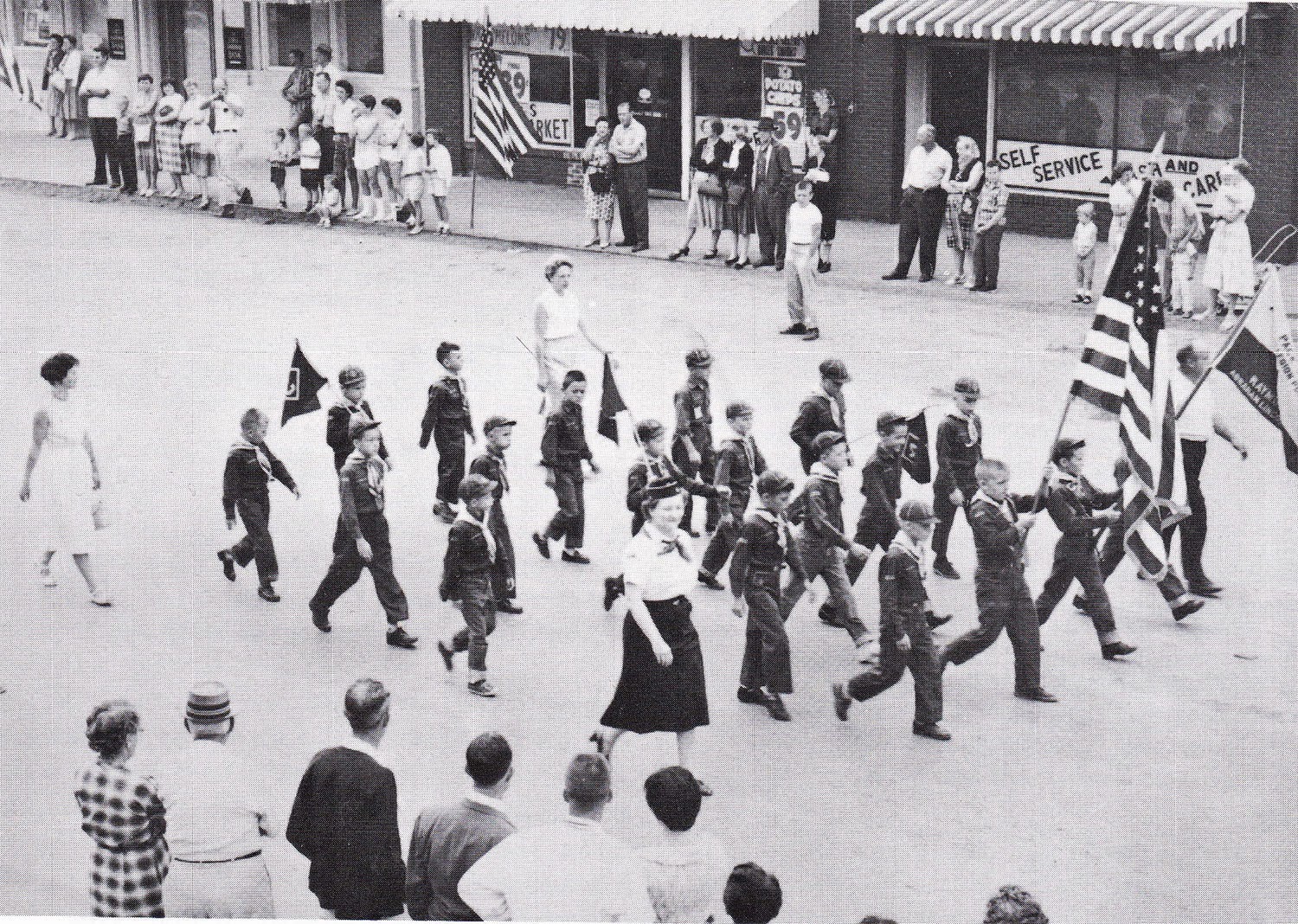
Boy Scouts marching in the parade in the late 1950's. (Scroll down for more photos)
(The following information was taken from Raymond's 125th Anniversary Book that was published in 1996.)

The annual Independence Celebration is a tradition in Raymond. It is held on Broad Street for three days, usually on or near July 4th. The event is planned and organized by members of the Raymond Fourth of July Association which consists of representatives from American Legion Post #299, the Raymond-Harvel Fire Department, and-Raymond Knights of Columbus Council #4696, along with other volunteers. Other community organizations and individuals also help fund the celebration and make the annual event a success. According to the July 10, 1958 issue of The Raymond News, 1958 marked the first year of the Raymond Independence Celebration as we know it today. According to the report, the American Legion sponsored a parade, fish fry and dance. The parade covered fourteen blocks, and featured the American Legion Color Guard and Rifle Squad consisting of World War II and Korean Veterans, and the Raymond High School band, under the direction of R.C. Jones. It is estimated that 500 people were served at the fish fry.

Prior to the days of the celebration on Broad Street, there are other reports of Independence festivities taking place in and near Raymond. Many people recall one 4th of July celebration that definitely went out with a "bang" at the Everett "Sonny" Glover family farm east of Raymond. On July 4, 1951 the Glover's 1949 Ford Station Wagon was completely destroyed when apparently, a box of aerial bombs on the tail gate of the wagon became ignited and blew up, completely wrecking the car and throwing glass from the windows about 200 feet. No one was seriously injured in the mishap, although one person received a cut lip from the flying glass. A nearby wheat field also caught fire, but was extinguished before much damage was done.

Other references to early Raymond Independence Day Celebrations indicate the city cannon was shot off from under the cottonwood tree.

Today, the Independence Celebration is held on Broad Street and highlighted by the "big" parade, the coronation of Miss Independence and the Little Miss and Mr. Muscle, entertainment, carnival rides, concessions, and the fireworks display. It draws large crowds from Raymond and the surrounding communities.


------------------------------------------------------------------------------------------------------------------------------------------------------------------

I decided to feature Raymond's Independence Day Celebration in this week's blog to coincide with the event that kicked off tonight and goes through Saturday night. This annual event was one of the highlights of the summer when I was growing up, and I have so many great memories of the sights, sounds, and smells from those days.

One thing that sticks out in my memory is the number of people who came to town for the celebration. The parking spaces on the northwest side of Main Street were always full, and it was difficult to find parking on any of the side streets for several blocks. Back then, it was two fun-filled days of eating junk food, riding cheap carnival rides, playing games, running around uptown unsupervised, and watching the Lester Family on the stage. The Kiddie Parade was big, and the big Parade was really big. In addition to the Lincolnwood Band, three or four other marching bands from neighboring towns participated (this was back when each high school marching band had about seventy kids in it). There were also dozens of floats from local businesses and organizations in Raymond and from nearby communities (who can forget the Witt Lions Club float!). Of course there were also tractors and horses, and plenty of politicians. Hundreds of people lined the streets of Raymond for the parade. We always sat in Margie and Louie Krause's yard, and it's nice to know that several of my siblings and some of their kids will be back in the neighborhood at that spot for the parade this Saturday. 

I remember walking up Main Street and hearing songs like "Black Betty" by Ram Jam and "Mississippi Queen" by Mountain blasting over and over from the Tilt-A-Whirl. Mom always started in with her warnings about the "carnies" each year in mid-June, and I was forbidden to walk uptown or back home alone when the carnival was in town. This meant I would be forced to carry around the goldfish I won in a small baggie, trying to find one of my sisters to walk me home before the fish died. As you continued up Main Street out of earshot of the carnival, you would hear the familiar voices of the volunteer fireman ("B 12. BEEEE 12. Under the G, 42, GEEEE 42. Hold your card, folks, we have a Bingo!"), and the lucky winner might have gotten 50 cents or even a dollar, depending on how many people were playing. And then there was the food... Pronto Pups, cotton candy, the KC fish stand, the Pork Producers stand, the Raymond Methodist Church Lemonade Shake-ups, and of course homemade ice cream that was made with, dare I say it, RAW eggs! We lived on the edge back then.

Since Dad was on the Fire Department, we were allowed on the Gun Club grounds during the fireworks. I would meet up with him around dark, and we would make a stop at that small concession stand that was always set up near Mizera's. They served ice cream bars covered with chocolate and nuts, and we would enjoy ours as we made our way to the Gun Club. I seem to remember that the folks who ran that stand were from Nokomis and they came to Raymond's celebration for many years.

Back in those days, the fireworks were lit by hand, and Carl Peger and Gene Adams were in charge. From out seats on top of one of the firetrucks, we could see their silhouettes and their flares over in the distance. They would bend down, light the fuse, and then run like hell. A few seconds later, you would hear a loud swishing noise, and a single firework would shoot up into the sky and everyone would "oooh" and "ahhhh."  The fireworks went up one at a time for about thirty minutes until the finale, when they lit up a display that was shaped like the American Flag.

By the time we made it back uptown after the fireworks, the stands and the rides were being disassembled and the streets were being cleaned. By the next day, you could hardly tell that anything even happened.


American Legion float around 1960. From left -- Barb (Hannon) Boehler, Nancy (Bandy) Ryan, Chris (Hall) Meisner, Barb (Broaddus) Stephenson, and Russell Poggenpohl

A street scene of the 1967 celebration taken from on top of the Ferris wheel.


Rick Wagahoff and Rex Truebe in the early 1960's.

JP Masten and one of Bev and Bill Held's boys (Doug?) around 1990.


Friday, June 20, 2014

Summer Vacation

Earlier this week, I read a great piece by Melissa Fenton that was published in the Huntington Post about growing up in the 70's. It is entitled 10 Ways to Give Your Kids an Honest-to-Goodness 1970s Summer." It's definitely worth checking out and I think many people of a certain age will relate to it: (http://www.huffingtonpost.com/melissa-fenton/10-ways-to-give-your-kids-an-honest-to-goodness-1l970s-summer_b_5484462.htm).

It reminded me of my carefree childhood years during the 70's, and it helped bring back many wonderful memories of growing up in Raymond:  
  • Playing at the "new" Raymond Park when the trees were just small saplings and there was no shade. The brand new aluminum sliding board seemed so tall, and it got so hot in the summer. We played on it anyway, and always brought a couple of sheets of wax paper along for maximum sliding potential.
  • Playing Hide and Seek, Red Light/Green Light, Mother May I, and Red Rover until the streetlights came on.
  • Pam being grounded for not going home when the streetlights came on.
  • Running Lemonade/Koolaid stands at the corner of  Oak Street and the Black Diamond/East Road. If business was good and we ran out of styrofoam cups, we borrowed those plastic, pastel Tupperware glasses from someone's mom and promised to return them.
  • Having walnut fights, mudball fights, water fights, and even BB gun fights with the neighborhood boys (Rick and Joe Ondrey, Toby and Keith Dean, and Danny Bob Hough). Also, playing "school" in our garage with that same crew (Pam and I were always the teachers).
  • Riding our bikes directly behind the bug sprayer (inhaling all that insecticide and loving the smell of it!).
  • Riding a go cart with the Ondrey boys up and down the street in front of their house, and riding a mini-bike and three wheeler with Brenda and Roger Myers in the alley next to the Standard Station. (I never wore a helmet and I almost always got a burn on my right leg from the exhaust pipe, but it was so much fun, who cared?)  
  • Staying up all night playing Clue and Aggravation with Dena in the Pitchford family camper that was parked in their driveway. 
  • Going to Bible School.
  • Sunday afternoon fishing with Dad -- usually we would go to the Five Mile Bridge for a few hours, and then make a stop at Horseradish Lane to see if anything was biting. The last stop, around dusk, would always be the Gun Club so we could use up the worms.   
  • Waking up with poison ivy after the Sunday fishing trip.
  • Visiting with the next door neighbors after supper. Everyone would bring lawn chairs to Marge and Louie Krause's house and shoot the breeze in the side yard.
  • Playing with the Lanter kids (from the other side of town) when they visited their Aunt Jane's house. Looking for fossils with Sherri in Jane's landscaping rocks.
  • Swinging on the rope swing in John and Dot Hough's back yard and then taking a break and eating apples off the trees in Mitch and Helen Engleman's back yard.
  • Having a stomachache after eating too many green apples at Engleman's.
  • Swimming at Camp Jomoco.
  • Hanging out uptown at "The Gallery" with Robin Niepert, inventing new drinks at the soda fountain, and then walking a few doors down to the Lincolnwood Community Reading Center. Rita Todt was the librarian and she always helped us select just the right book.
  • Alternating between playing with Matchbox cars and my Barbie camper.
  • And the perfect end to a long summer day --  Going to the Lancer Den for ice cream, then riding around town in the back of Dad's pick-up truck, listening to the Card's game on KMOX. 

Friday, June 13, 2014

The Cottonwood Tree

The Cottonwood Tree next to the train depot in 1971
I usually drive to Raymond at least once a year, by way of Interstate 70 to Vandalia and then wind my way up to Hillsboro on Rt. 185. I know that when I reach the first curve just south of Raymond, it would be most logical to take the Black Diamond short-cut and head straight to one of my sisters' houses. Instead, I follow Rt. 127 into town, make the right turn on Rt. 48 and then turn on Main Street, just to get a glimpse of the Cottonwood Tree, towering majestically over the village of Raymond. That's when I know I am finally home.

I've always been fascinated by it. Depending on the season, it's either flourishing with bright green triangular shaped leaves, or it appears stark and gray, it's bare crooked limbs reaching, almost painfully, toward the sky. I'm sure it got its start just like any other ordinary cottonwood tree back in the prairie days: a small seed floating on a cottony fiber in the breeze, swirling around oak trees and mulberry bushes, escaping all those beady-eyed Blue Jays that snapped at it and missed. By the time the seed made it to the tree's current spot, it was likely hanging by a thread as it skipped from rock to rock along the banks of the pond that was once located where Sorrells Elevator is today. Luckily, it landed in the dark rich soil that Montgomery County has always been known for; some of the same soil, that Abe Lincoln walked on as he journeyed to the Illinois State Capital, and the very soil that had once been marked by the footprints of slaves heading North on the Underground Railroad. 

As strange as this might sound, I've often thought of the tree as having a personality; after all, it's always there, overseeing all the comings and goings of everyone in town. It has withstood thunderstorms, and snowstorms, and debilitating ice storms, and stood by during joyous town celebrations as well as tragic accidents that occurred on the railroad tracks, just outside its reach. For those who served in the world wars, the Cottonwood Tree was probably the last thing they saw in Raymond as their train crossed the trestle and rounded the bend south out of town, and the first thing they saw when they returned as heroes years later. Of course, the unlucky ones never knew that its branches carried the echoes of the 21 gun salute on the day they were buried.

Experts will tell you that few cottonwood trees live to be over 100 years old. Based on the rings around its trunk, Raymond's Cottonwood Tree is estimated to be over 140 years old. I find it amazing to think that three generations of my family have come and gone, and the tree still stands. I hope it will continue to greet me when I return home, for many years to come.   

---------------------------------------------------------------------------------------------------------------------------------------
If you're interested, following is some of the history of the
Cottonwood Tree that was printed in 
Raymond's 125th Anniversary Book in 1996: 

Raymond's one and only claim to a landmark is the famed Cottonwood Tree located next to the Wabash tracks on main street. This Cottonwood tree was a small sapling when the City of Raymond was founded, prior to the arrival of the Wabash Railroad in 1871, which resulted in the establishment of Raymond as a town. Joe Henry farmed around the tree, which was at that time on the bank of a pond. About the turn of the century, the trunk of the tree became hollow but remained alive and was used as a storage shelter by the grainman, L.C. McClurg .  He would store his scoop and end gate in the hollow area of the tree. The hollowed area was said to be big enough to enable a man to stand upright in the trunk . 

At any rate, the tree was always the center of activity during the community's annual July 4th festivities. The city's cannon was brought out of moth balls on Independence Day and shot off underneath the tree. Wabash railway officials threatened to cut the tree down two or three times, but refrained after receiving protests from the townspeople who have come to prize the old landmark. As late as 1958, the Raymond community exercised their right of petition and presented their formal protest to the railroad officials when the tree was again threatened with removal. With the support of the community and the request of the Town Board, the tree was saved. The tree is on Wabash property, beside the tracks, near the old depot, now a village parking lot. Old timers remember when the sake of the tree was a popular spot to meet and discuss community developments. The tree was a popular vending spot for local fish and watermelon "drummers" (salesman).


One report has it that the tree became hollow as a result of being burned by a bonfire during a Fourth of July celebration . H.H. Weatherford , in an article on April  15, 1897, says that John Bruscoe was killed by the explosion of powder on July 29, 1876, under the cottonwood tree on Main Street. Bruscoe was the proprietor of the local hotel. As one searches through reams of paper, conflicting stories are found , as to what actually happened.